Shelby Knowledge · Anatomy & movement

The Arabian athlete.

A source-aware introduction to the purebred Arabian's exterior, skeleton, muscles, distal limb and hoof — and to how those parts work together in motion.

Start with the whole

See the horse as a system.

A racehorse does not run with one muscle or one special bone. Skeleton, joints, muscles, tendons, ligaments, hooves, nervous system and conditioning must work together — in that individual horse.

This first chapter teaches orientation and a better language for observing movement. It does not replace veterinary examination, diagnostic imaging, farriery assessment or individual training design.

Anatomy atlas · Three layers

Movement begins beneath the skin.

Our own anatomy plates use Sanoor, Kaitana and the hoof as educational orientation. They explain structure and function — not an individual clinical diagnosis.

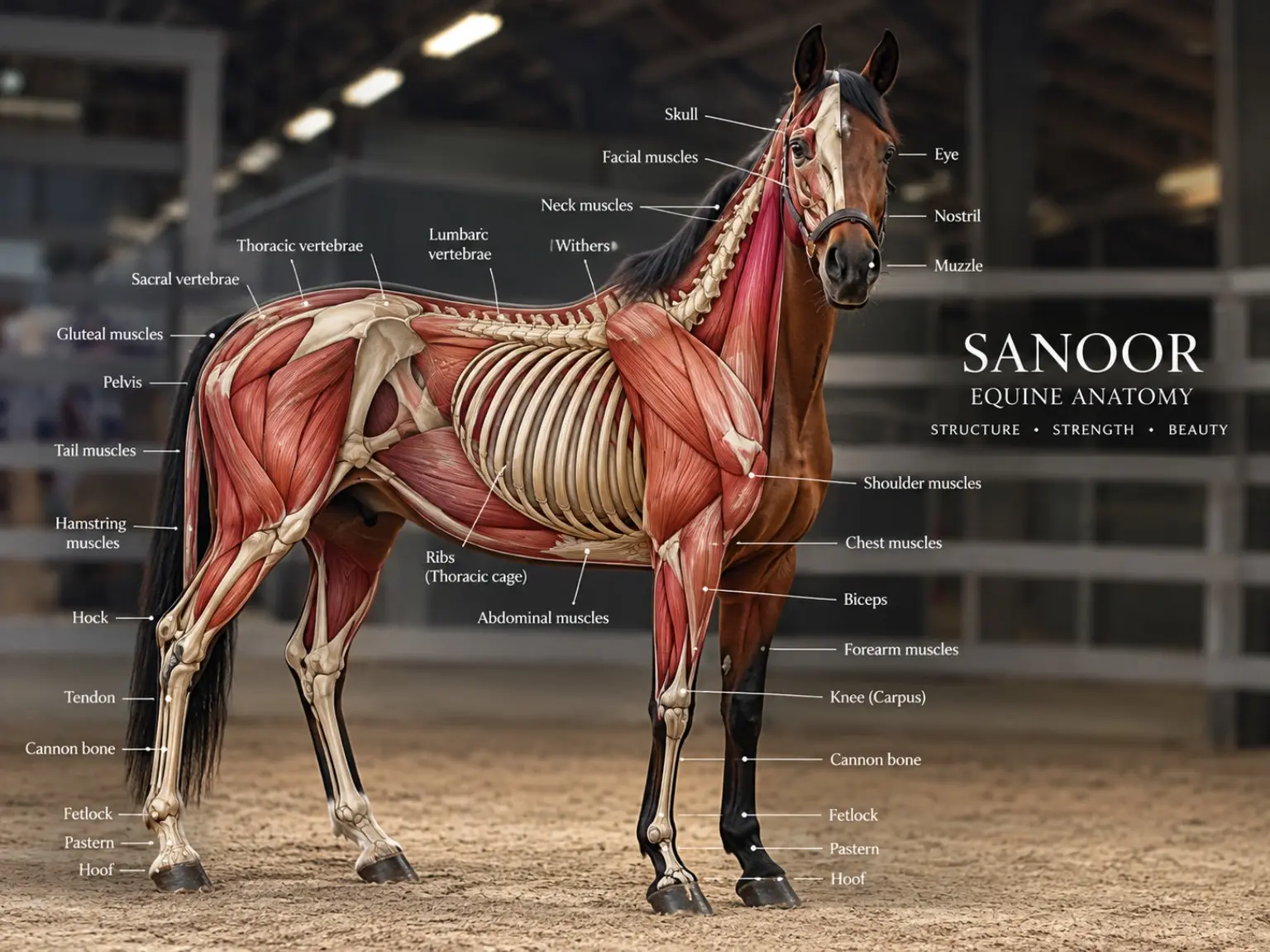
Original anatomy illustration of Sanoor with the skeleton, spine, ribs and major muscle groups labelled
Visual: 1919 by Shelby AB · Sanoor anatomy studyOur visual · 1919 by Shelby AB
01

Skeleton & joints

Bones give the body structure and meet at joints that shape the direction and range of movement. Begin with the scapula, regions of the spine, pelvis and the long chain down to the hoof.

Scapula
shoulder blade
Vertebrae thoracicae et lumbales
thoracic and lumbar vertebrae
Pelvis
pelvis
Metacarpus III
cannon bone
Phalanges
phalanges
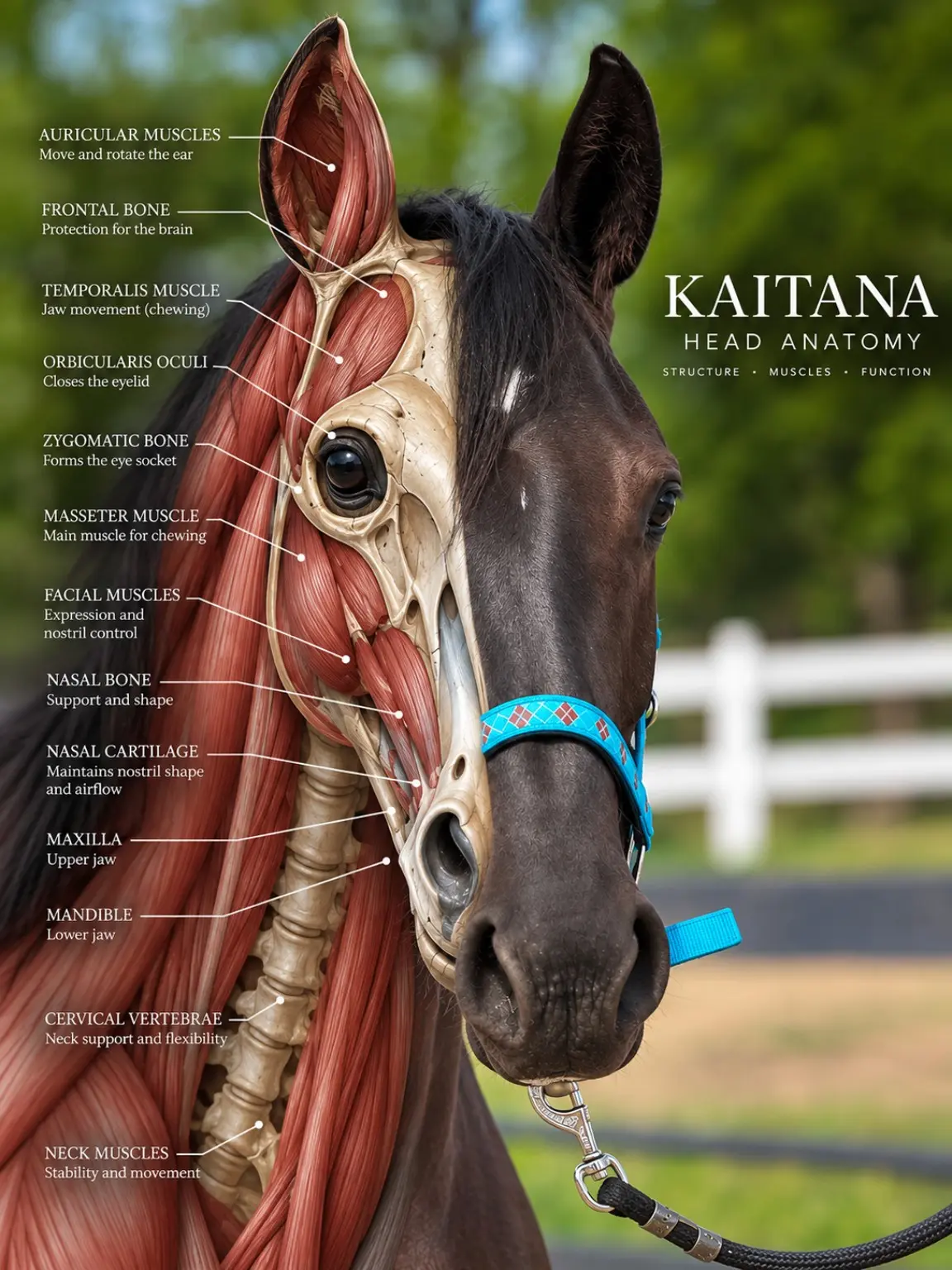
Original anatomy illustration of Kaitana's head with skull, facial muscles, ear muscles and neck labelled
Visual: 1919 by Shelby AB · Kaitana head anatomyOur visual · 1919 by Shelby AB
02

Superficial muscles

Skeletal muscles create posture and movement by acting across joints. Size alone cannot tell us how well a muscle chain is coordinated, conditioned or recovered.

M. trapezius
trapezius
M. latissimus dorsi
latissimus dorsi
M. longissimus dorsi
longissimus dorsi
M. gluteus medius
middle gluteal
M. biceps femoris
biceps femoris
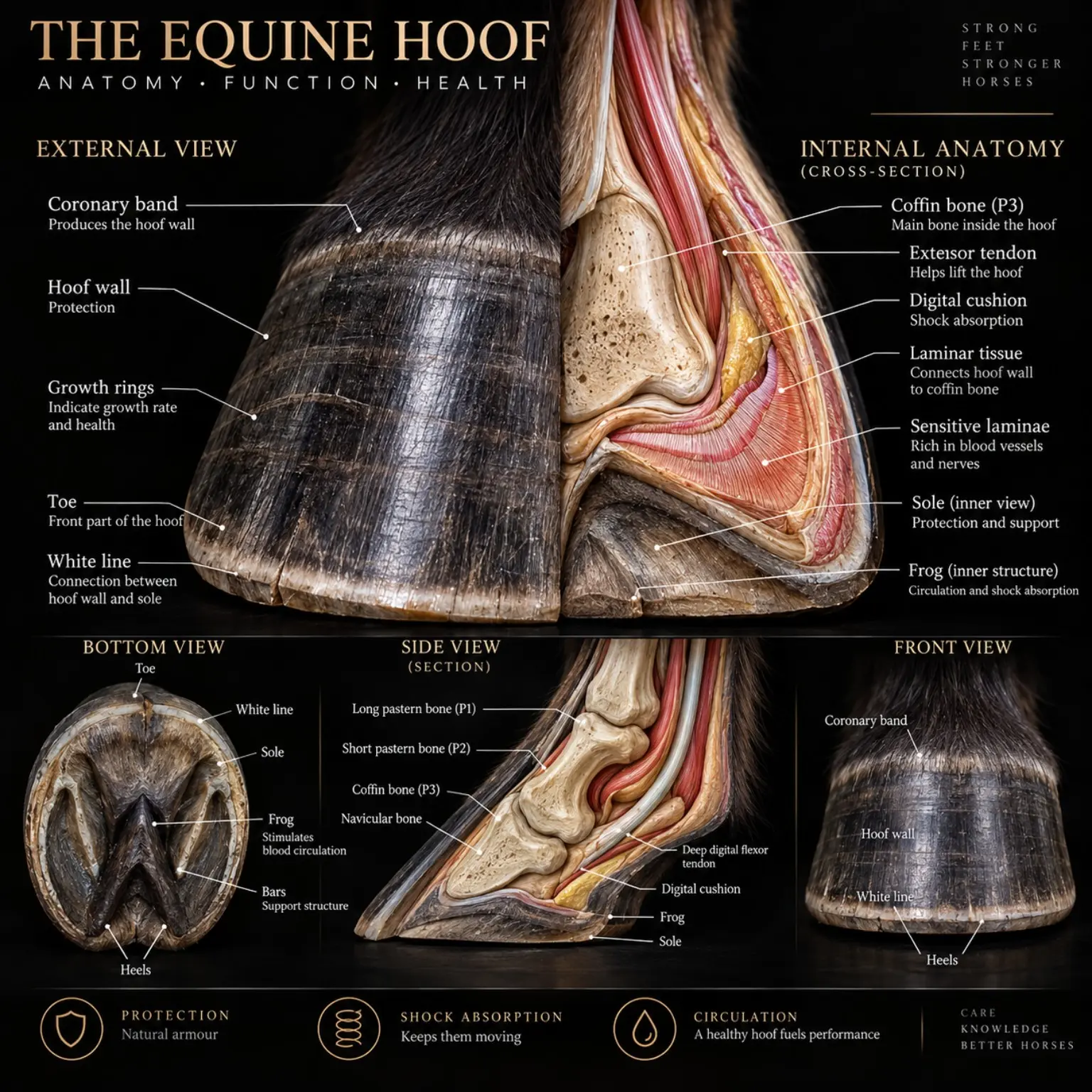
Original anatomy illustration of the equine hoof with hoof capsule, coffin bone, laminae, frog and soft tissue labelled
Visual: 1919 by Shelby AB · Equine hoof anatomyOur visual · 1919 by Shelby AB
03

Distal limb & hoof

The hoof is not simply a hard shell. The hoof capsule surrounds bone and living soft tissue, while tendons and ligaments transmit and stabilise load through the lowest part of the limb.

Phalanx distalis · P3
coffin bone / distal phalanx
Os sesamoideum distale
navicular bone
Tendo flexor digitalis profundus
deep digital flexor tendon
Pulvinus digitalis
digital cushion
Paries et lamellae
hoof wall and laminae

The purebred Arabian

Distinct breed type. No magic body part.

The purebred Arabian is recognised through a combination of exterior traits and documented stud-book status. No single profile, vertebra or muscle guarantees speed, soundness or endurance.

01

Head & neck

A refined wedge-shaped head, broad forehead, large eyes, wide nostrils and a small muzzle belong to the classic description. A concave profile is breed type — not proof of better breathing or performance.

02

Topline & tail

A well-set arched neck, relatively level croup and naturally high tail carriage help form the recognisable silhouette. Function must still be assessed in movement and for the intended discipline.

03

Registration, not eyesight

Under the WAHO definition, purebred status comes from entry in an accepted purebred Arabian stud book or register — not simply from looking Arabian.

04

The racing individual

A performance Arabian may look different from an extreme show type. Correctness, symmetry, quality of movement, history, health and suitability for the task matter more than one exterior ideal.

Fact or myth?

Five claims that need context.

The text separates general equine anatomy, classic Arabian breed type and individual variation. The anatomy images are original educational material for 1919 by Shelby AB and do not replace individual anatomical assessment.

01Myth
Claim

Every Arabian has 17 pairs of ribs.

Rib and vertebral counts can vary between individuals and populations. A breed name cannot establish one horse's anatomy; examination or diagnostic imaging is required.

02Not established
Claim

Fewer lumbar vertebrae automatically create endurance.

Endurance and racing performance are multifactorial. A simple vertebral count cannot explain conditioning, metabolism, movement economy, training or results on its own.

03Not established
Claim

A deeper facial dish means better airflow.

The concave profile is a breed-type feature. It should not be used as a performance metric or as a substitute for clinical assessment of the airways.

04Myth
Claim

Muscles work in isolation.

Movement emerges from muscles, bones, joints, tendons, ligaments and the nervous system working together. Observe the chain and its coordination.

05Myth
Claim

The hoof is only horn.

The outer horn protects a complex structure containing the coffin bone, navicular bone, tendons, laminae, blood supply and other soft tissues.

Anatomy in motion · Jägersro

Watch the system, not one part.

Mayhaab's training film makes the theory tangible: forehand, trunk, hindquarters and distal limbs coordinate in every stride. This is stable footage, not a clinical gait analysis.

01

Forehand

Receives and redirects load through the shoulder, elbow, carpus and hoof.

02

Trunk

Stabilises and transfers force between front and hind without turning the back into a completely rigid bridge.

03

Hindquarters

Pelvis, hip, stifle and hock work with large muscle groups to contribute propulsion.

04

Distal limb

Tendons, ligaments and the hoof carry load through the final link to the ground.

Mayhaab · Jägersro · jockey Josefin LandgrenANATOMY IN MOTION

Watch in slow motion

Five things to follow.

One camera angle can mislead the eye. Compare several strides, both directions, different speeds and a relevant surface. If pain or lameness is suspected, stop and contact a veterinarian.

  1. 01
    Rhythm

    Are the strides even while speed and surface remain stable?

  2. 02
    Symmetry

    Do right and left sides move similarly across several sequences?

  3. 03
    Topline

    How do the head, neck and back change between loading and suspension?

  4. 04
    Landing

    Where and how does the hoof meet the ground from this camera angle?

  5. 05
    Recovery

    How do breathing, rhythm and body language change after work?

Sources & method

Continue with the original sources.

The text separates general equine anatomy, classic Arabian breed type and individual variation. The anatomy images are original educational material for 1919 by Shelby AB and do not replace individual anatomical assessment.

Continue in Shelby Knowledge

From the body to the bloodline.

Build the whole picture through our horse dossiers, Bloodline Lessons and practical racing guide.

Open the Arabian Galopp Archive Open the racing guide